
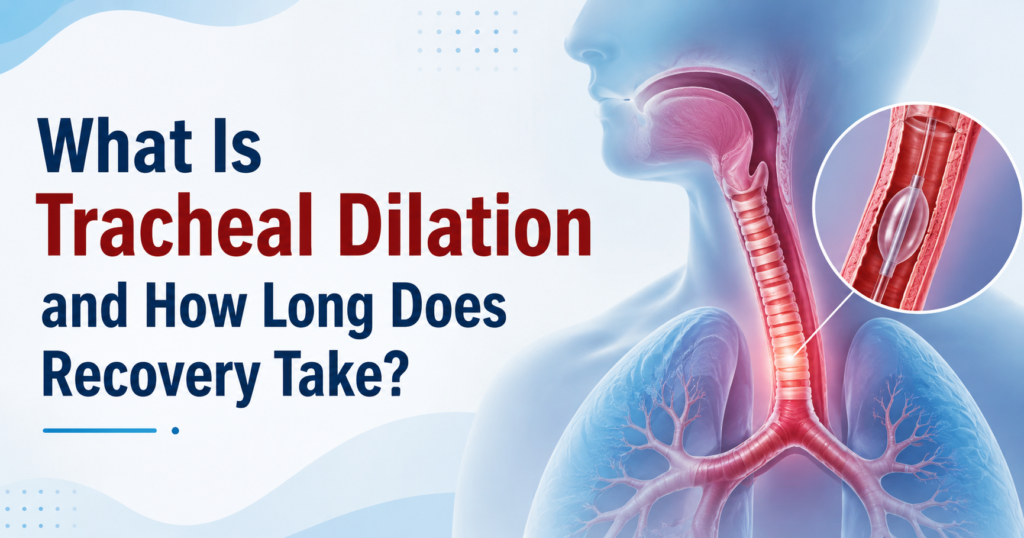
What Is Tracheal Dilation and How Long Does Recovery Take?
What Is Tracheal Dilation?
The trachea — your windpipe — is the airway that carries every breath from your throat to your lungs. When this passage becomes narrower than it should be, even simple tasks like walking or talking can leave you short of breath.
Tracheal dilation is a procedure designed to gently open up this narrowed section. Think of it as carefully widening a partially blocked pipe so air can flow through freely again.
The procedure is typically performed using a bronchoscope — a thin, flexible tube with a camera — that is guided into the airway to reach the affected area. It does not require open surgery in most cases.
Why Might Someone Need Tracheal Dilation?
Several conditions can cause the trachea to become narrow:
-
- Tracheal stenosis — An abnormal narrowing of the windpipe, which may develop over time or, in rare cases, be present from birth
-
- Scar tissue after prolonged intubation — When a breathing tube is kept in place for extended periods (such as after major surgery or in an ICU), the trachea can develop internal scar tissue
-
- Airway injury — Physical trauma to the neck or chest may damage or compress the trachea
-
- Inflammatory conditions — Certain diseases, such as Wegener’s granulomatosis or relapsing polychondritis, can inflame and gradually narrow the airway
-
- Benign or malignant growths — Tumors or other masses near the trachea can press against it, reducing airflow
Tracheal narrowing is often mistaken for asthma or a chest infection in the early stages. This is why an accurate diagnosis from a pulmonologist matters — breathing difficulties should never be dismissed without a proper evaluation.
How Is the Procedure Performed?
Tracheal dilation is typically done under sedation or general anesthesia, so patients are comfortable throughout.
A bronchoscope is passed through the mouth or nose into the airway. Once the narrowed segment is identified, the pulmonologist opens it using one of the following approaches:
-
- Balloon dilation — A small balloon is guided into the narrow area and inflated carefully to stretch the airway open
-
- Rigid dilation — A slightly wider instrument is passed through progressively to gradually open the passage
-
- Laser-assisted dilation — In selected cases, a laser may be used to remove excess scar tissue before dilation
The procedure generally takes between 30 and 60 minutes. Many patients are discharged on the same day; some may stay overnight for observation.
How Long Does Recovery Take?
Recovery after tracheal dilation is generally quicker than people expect.
In the first few hours: After the procedure, you will rest in a monitored recovery area. Nurses will check your oxygen levels and breathing before you are cleared to go home or to a regular ward.
In the first 1–3 days: A mild sore throat, slight cough, and a temporary hoarse voice are common. These are expected and usually settle on their own.
Return to normal activity: Most patients are back to light daily activities — walking, gentle housework, desk work — within one to two days. Strenuous exercise, heavy lifting, and physical exertion should be avoided for at least a week or as advised by your doctor.
Follow-up care: Regular follow-up appointments are not just recommended — they are essential. Tracheal stenosis can recur in some patients, and catching it early makes treatment far more manageable.
Recovery timelines can vary based on the underlying cause of airway narrowing, the extent of the procedure, and overall health. Your treating pulmonologist will give you a personalised recovery plan.
What Should You Expect After Tracheal Dilation?
Mild, short-lived symptoms after the procedure are normal. These include:
-
- Mild throat soreness (typically resolves in 2–4 days)
-
- Temporary cough or the urge to clear your throat
-
- Slight difficulty swallowing in the first day
-
- A hoarse or slightly changed voice for a short period
These symptoms do not require a visit to the hospital and improve with rest, hydration, and following your doctor’s instructions.
Seek immediate medical attention if you experience:
-
- A sudden return or worsening of breathing difficulty
-
- A high-pitched sound when breathing in (this is called stridor — it suggests airway narrowing)
-
- Coughing up blood
-
- Severe chest pain or tightness
-
- High fever (above 38.5°C)
These symptoms are not normal and require prompt evaluation. Do not wait.
Expert Tips from Dr. Sumita Agrawal
✔ Follow post-procedure instructions exactly. Your pulmonologist will provide specific guidance — these instructions are tailored to your situation and following them reduces the risk of complications.
✔ Avoid all forms of smoking during recovery. Smoking irritates the airway lining and significantly delays healing. Passive (second-hand) smoke also has the same effect — avoid it during recovery.
✔ Never skip follow-up appointments. Tracheal stenosis is known to recur in a portion of patients. Monitoring does not end when symptoms improve; it continues until your doctor confirms the airway is stable.
✔ Report worsening breathing without delay. If you feel your breathing has become more restricted after initially improving, contact your doctor the same day. Early intervention is far simpler than managing a recurrence.
✔ Stay well hydrated. Drinking adequate water keeps the airway moist and supports the healing of tissue. Avoid very hot or very cold beverages in the first few days.
✔ Do not ignore recurring symptoms. If breathlessness, stridor, or noisy breathing returns weeks or months after the procedure, do not assume it will pass. Schedule an evaluation promptly — it may indicate re-narrowing that can be treated before it worsens.
When Should You Consult a Pulmonologist?
Many patients live with airway narrowing for months before seeking help — often because symptoms are gradual or mistaken for something else. Early evaluation is always better.
See a pulmonologist if you are experiencing:
-
- Persistent breathlessness — especially if it is getting worse over weeks or months
-
- Noisy breathing — a high-pitched or wheezing sound with each breath, particularly when breathing in
-
- A feeling that air is not moving freely — as though something is partially blocking your airway
-
- Worsening breathing following surgery or a long ICU stay — this raises the possibility of post-intubation tracheal stenosis, which requires specific investigation
A pulmonologist can assess your airway with appropriate diagnostic tools and recommend whether tracheal dilation or another form of airway narrowing treatment is right for you.
Conclusion
Tracheal dilation is a well-established, minimally invasive procedure that can meaningfully improve breathing and quality of life for those with airway narrowing.
Recovery is usually quicker than expected, and most patients notice a significant difference in breathing almost immediately after the procedure. The key to good outcomes is early diagnosis, appropriate treatment, and consistent follow-up care.
If breathing difficulties are affecting your daily life, there is no reason to manage them alone. A pulmonologist can evaluate your airway, identify the cause, and help you breathe easier.
Need Expert Respiratory Care?
If you are experiencing breathing difficulties — or have been advised to undergo tracheal dilation — speaking with an experienced pulmonologist can help you understand your options and feel confident about your treatment plan.
Consult Dr. Sumita Agrawal, Pulmonologist & Chest Physician in Jodhpur, for advanced, patient-centred pulmonary care.
FAQ’S
Q1: What is tracheal dilation used for?
It is used to widen a narrowed windpipe (trachea) so air can flow freely. It helps patients with tracheal stenosis, scar tissue buildup, or airway blockage breathe more comfortably.
Q2: How long does tracheal dilation take?
The procedure usually takes 30 to 60 minutes. Most patients go home the same day or after a short overnight stay for observation.
Q3: Is tracheal dilation safe?
Yes, it is generally considered a safe and minimally invasive procedure. Like any medical procedure, it carries some risk, which your pulmonologist will discuss with you beforehand.
Q4: How soon will I breathe better after tracheal dilation?
Most patients notice improved breathing almost immediately or within the first 24 to 48 hours after the procedure.
Q5: Can tracheal dilation be repeated if needed?
Yes. If the airway narrows again over time, the procedure can be repeated. Regular follow-up with your pulmonologist ensures any recurrence is caught and treated early.